The 9 Dots Problem

The best hint, in my view, is to mention that often, when solving a problem, we implicitly impose constraints that have not come with the problem. One classical example is where nine dots are arranged on the sides and the center of a square as in the picture below.
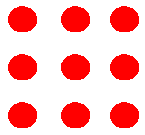
The problem is to connect the dots with no more than 4 straight lines without lifting your hand from the paper. First attempts are always frustrating. For one always comes up with 5 lines instead of 4.

The solution lies in the observation that it's permissible to cross square boundaries.

Now, try to think of a restriction you imposed on yourself which was not inherent to the problem.

As an aside, Lars Hellvig from Stockholm, Sweden picks up this line of thought and points out even more of self-imposed restrictions that I missed considering the 9-point problem above.

Xinding Sun from University of California, Santa Barbara found yet another twist to the problem.

Further variants are discussed at the CTK Exchange - the old archive.

|Contact| |Front page| |Contents| |Store| |Up|

Copyright © 1996-2012 Alexander Bogomolny

 40607967

A math books store at a unique math study site. Shopping at the store helps maintain the site. Thank you.
Sites for teachers
Sites for parents
Terms of use
Awards
Interactive Activities

CTK Exchange
CTK Wiki Math
CTK Insights - a blog
Math Help
Games & Puzzles
What Is What
Arithmetic
Algebra
Geometry
Probability
Outline Mathematics
Make an Identity
Book Reviews
Stories for Young
Eye Opener
Analog Gadgets
Inventor's Paradox
Did you know?...
Proofs
Math as Language
Things Impossible
Visual Illusions
My Logo
Math Poll
Cut The Knot!
MSET99 Talk
Old and nice bookstore
Other Math sites
Front Page
Movie shortcuts
Personal info
Privacy Policy

Guest book
News sites

Recommend this site

Sites for parents

Education & Parenting

Search:
Keywords:

Google
Web CTK
Supported by
3wVentures