
Other sites of interest
A site for gifted math students, especially those planning to participate in various math olympiads. Created by former olympiad winners, the site offers an online school, a variety of forums and improvisational problem solving sessions guided by Art of Problem Solving instructors. |
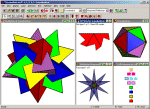
Great Stella is by far the most comprehensive tool around for exploring the fascinating world of polyhedra. Select from over 200 built-in models (including Platonic, Archimedean, Kepler-Poinsot and all other uniform polyhedra, Johnson solids and Stewart toroids), or create endless new ones using advanced tools such as duality, stellation, faceting, and augmentation. Also comes with a library containing hundreds of additional models so you can take advantage of the power without learning all the ins and outs. Nets can be printed for any polyhedron created, allowing you to build your own physical models with a bit of cutting, folding and gluing. Photos of many models built using the program also appear on the site, as well as a published paper about the features of the program, and a glossary of polyhedral terms. |
A rare and, probably, the most comprehensive collection of mathematical information available on the Web. This is a dynamic extension of Eric's hardcopy Encyclopedia of Mathematics. There are close to 9,000 entries each with book references and links to related Web sites. Some topics are covered better than others, but in most cases you may expect to glean a good deal of information on a huge variety of topics in Mathematics.
The site underwent several major revisions. In its latest incarnation, it features an exemplary user interface with multiple entry points and a powerful search engine. |
One of the most comprehensive Web resource sites. Teaching material, Math related sites, Journals and Magazines, Government Institutions, Societies and Colleges, Math Departments. |
A collection of mathematical assays maintained at the University of Waterloo. Covers many topics in history, algebra (mostly higher), number systems and Number Theory and more. Special pages describe Famous problems in Mathematics. The site is a valuable on-line source of information but not as comprehensive or well organized as Eric's Treasure Trove. But there is a promise hence the hope. |
Mathematical archives. A most remarkable and well organized site. Plenty of information not all of which is actually historical. Information can be accessed (and, therefore, searched for) in a variety of ways - several indices, chronologies, birthplace map. There is also a page of Famous curves that uses Java extensively. |
A place where one can spend hours traveling back and force between various links. Information is organized into several categories: Specialized Fields (there are quite a few specialized fields indeed. Suits any taste), Mathematics Department Web Servers (check to see if any college was missing), General Resources (links to sites all over the world), Math Education and more. |
By a professor of Information and Computer Science at the UC Irvine. A very respectable collection of problems, articles and applications available on the Net. Much of it created by the author himself. The page is split into several topics: The Geometry Junkyard, Number Theory, Recreational Mathematics, Combinatorial Game Theory. Each one of these would qualify the page for any list of Net resources. Here you can also find selected links to other personal pages with math content. |
Originally a fundamental undertaking by Swarthmore College, the Math Forum is now part of the School of Education at Drexel University. Resources for students and teachers. Internet programs and activities. Ask Dr. Math. Teacher2Teacher, Math Tools. Math Fundamentals, Pre-Algebra, Algebra and Geometry Problems of the Week. Topics in Math Education. Dynamic Geometry software experience. The site is the hub of the math education activity on the Web. |
A site by George Hart of Hofstra University. Internet at its best. VRML models of all kinds of polyhedra. About 850 in all. Direction how to create one's own paper models. |
A page by Canadian Mathematical Community. Every week they present a new selection weaving a braid of math sites on the Net. I think it's quite imaginative to associate a Web page by the Canada's Math Community with a camel instead of a husky. |
A list of math related sites maintained by The Mathematics Archives. In their own words: Did you ever wonder what made your teacher get so excited about some topic in Mathematics? On this page, we will try to collect items about Mathematics one of which hopefully may explain this weird behavior. |
The site contains many of the definitions and theorems from the area of mathematics generally called abstract algebra. It is based on the two books Abstract Algebra and Abstract Algebra, II by by John A. Beachy and William D. Blair. Plenty of information. |
A site maintained by Joe Fields, U. Illinois at Chicago. Combinatorics must be a comprehensive field for the 'A' section includes Affine Hull and Affine Plane and Abelian groups. The author also accepts inquiries for new entries. |
I ran into this site while looking for Internet coverage of continued fractions. As far as I understand, it's a collection of facts and documented ideas generated at the AI Lab of M.I.T. under a grant from ARPA. Thus whatever you find there is free for the taking. The collection is very stimulating. What do they think about there? Geometry, Age bra, Calculus, Recurrence relations, Boolean Algebra, Random numbers, Number Theory, Primes, Probability, Automata Theory, Games, Continued fractions (of course), - nah, I just can't enumerate everything. |
|
A well organized collection of topics each illustrated by one or more applets. A gallery of topics from introductory Calculus that are suitable for high school students and teachers and college freshmen. The design of the applets and the pages in general is admirably consistent. The authors have even managed to illustrate the notion of derivative with simple but entertaining puzzles. |
A collection of links and original puzzles from Binary Arts including a simulation of their famous Rush Hour sliding blocks puzzle. Three new layouts of the puzzle are added every week. |
A free wheeling column by John Paulos from Temple University. Paulos is the author of Innumeracy, Beyond Numeracy, Mathematician Reads a Newspaper and several other popular books. Always humorous and enjoyable articles of a keen observer of the world around him with a mind sharpened by mathematical practice. |
Have you ever come across a number sequence in your work (or play) - such as 1, 1, 2, 3, 6, 11, 23, 47, ... - and wanted to find out what was known about it (or even simply the next term)? This is the place to find out. Contact person: N. J. A. Sloane |
A novel edition of Euclid's Elements It promises to be the best so far. Among the tools used is The Geometry Applet which is getting improved all the time. I have not checked every Proposition but the ones I saw have been illustrated with this Java applet and the experience was enjoyable. The hypertext cross-references that accompany every proof are absolutely invaluable. The illustration for the Proposition VI.31 (better known as the Pythagorean Theorem). It's quite different from the one I have conjured up. |
A focal point site for every one interested in Triangle Geometry. The site classfies hundredth of remarkable points, lines, circles related to the triangle. New ones are added on a regular basis. The site is an online expansion of Clark Kimberling's book Triangle Centers and Center Triangles. |
Author and speaker Terry Stickels has dedicated his life to the pursuit of improving one's mental flexibility and creative problem solving skills . . . and making it fun. His books, calendars, card decks and newspaper columns are filled with fun and challenging puzzles that stretch the minds of even the best thinkers. At the site one can play with samples of Terry's creations and purchase many of his books. |
AgeOfPuzzles.com is a web part of a puzzle-book-web project entitled Age of Puzzles. The project makes a comprehensive mosaic of puzzles created by different people in different time and at different places. It's a Colorful Journey through Endless Patterns of Quick Wits! Peter Grabarchuk, a son of Serhiy, has a remarkable website of his own: |
The site displays scans of over 1000 different slide rules and scans of down-loadable slide rule instructions and manuals. It also has a very informative SR encyclopedia as well as other data of interest to slide rule collectors and educators. There are several sets (up to 25) of matching SR's that are available as loaners to teachers wishing to introduce SR's to students. |
Brain teasers, puzzles, optical illusions and games by Kevin Stone, IQ 151, a member of Mensa for over 18 years. |
Well known and unique downloadable games and puzzles, free online Flash and Java games. Some games, for example, Nim, Super Nim, Always 100 have a clear mathematical content and can be used for a meaningful and entertaining practice. A partner site, Sapphire Games offers even more entertainment, both online and for download. The site is a collection of Japanese puzzles, checkers, other downloadable and online games. |
|
Sheppard Software - makes learning fun. |
 Art of Problem Solving
 Stella - Polyhedron Navigator
 Eric Weisstein's World of Mathematics
 Mathematics Archives
 Frequently Asked Questions in
Mathematics
Frequently Asked Questions in
Mathematics MacTutor History
 Virtual Library: Mathematics
 David Eppstein's Home Page
 The Math Forum
 Virtual Polyhedra.
 Knot
A Braid of Links
Knot
A Braid of Links POPMathematics
 Abstract Algebra On Line
 On-line Dictionary of Combinatorics
 HAKMEM
 NRICH
NRICH maths online
 Puzzles.com
 Who's Counting?
 On-Line Encyclopedia of Integer Sequences









|Contact| |Front page| |Contents|
Copyright © 1996-2018 Alexander Bogomolny
74721627