
A Quadrilateral with 3 Equal Sides
What is this about?
A Mathematical Droodle
| What if applet does not run? |

|Activities| |Contact| |Front page| |Contents| |Geometry|
Copyright © 1996-2018 Alexander BogomolnyThe applet lets you manipulate a quadrilateral, ABCD, so as to maintain the equality of three sides:
BC = CD = AD.
Let E be the point of intersection of the diagonals. An interesting situation occurs when also

Clearly, in such cases, CE ≠ DE, for, otherwise, the quadrilateral would be a trapezoid. Interestingly, when this condition holds, invariably
Following M. Hajja (The Mathematical Gazette, v. 94, n. 531, Nov. 2010), let's introduce angles α, β, ... as shown:
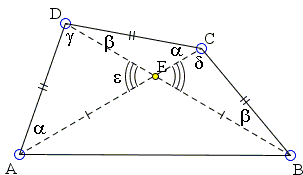
The focus of our interest are triangles ADE and BCE. In these triangles,
AE = BE, AD = BC, ∠AED = ∠BEC.
We are in a position to exploit the SSA situation. There are just two possibilities: Either the two triangles ADE and BCE are congruent, or
2α + β + γ = 180°,
α + 2β + δ = 180°.
Adding the two and taking into account that
α + β = 60°.
But, by the Exterior Angle Theorem, ε = α + β, and we are done.
Furthermore, again by the Exterior Angle Theorem, ∠ABE + ∠BAE = 60°, implying
|Activities| |Contact| |Front page| |Contents| |Geometry|
Copyright © 1996-2018 Alexander Bogomolny74284901