Cut the knot: learn to enjoy mathematics
A math books store at a unique math study site. Shopping at the store helps maintain the site. Thank you.
Learning Math Online
Sites for teachers
Sites for parents
Terms of use
Awards
Interactive Activities

CTK Exchange
CTK Wiki Math
CTK Insights - a blog
Math Help

III Millennium Olympiad

Games & Puzzles
What Is What
Arithmetic/Algebra
Geometry
Probability
Outline Mathematics
Make an Identity
Book Reviews
Stories for Young
Eye Opener
Analog Gadgets
Inventor's Paradox
Did you know?...
Proofs
Math as Language
Things Impossible
Visual Illusions
My Logo
Math Poll
Cut The Knot!
MSET99 Talk
Other Math sites
Front Page
Movie shortcuts
Personal info
Privacy Policy

Guest book
News sites

Recommend this site

Games to relax

Sites for teachers
Sites for parents

Education & Parenting

Manifesto  |  Bookstore  |  Contents  |  Amazon store  |  Term index  |  What changed?  |  Contact  |  Recommend
RSS Feed: Recent changes at CTK

Bender: Gerbino's Illusion

The applet below is a demonstration of an optical illusion. The idea behind the applet comes from [More Optical Illusions, p. 109]. Play with the applet and see if you can find out what is it about.


This applet requires Sun's Java VM 2 which your browser may perceive as a popup. Which it is not. If you want to see the applet work, visit Sun's website at http://www.java.com/en/download/index.jsp, download and install Java VM and enjoy the applet.


Buy this applet
What if applet does not run?

A few words.

Copyright © 1996-2009 Alexander Bogomolny


The applet shows polygons rotating at the vertices of a stationary one. Rotations could be centered at the vertices, or be a little displaced.
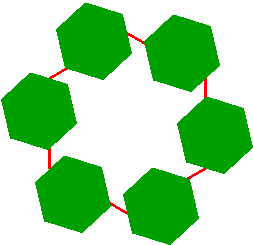
It could be observed that sometimes the sides of the stationary polygon appear to be misoriented, like in the first of the two figures above. In the second figure, the stationary shape appears to be circular rather than hexagonal.

Among the stationary figures, the triangle appears the least susceptible to the illusion, while, as the rotating shape, it's the most useful. The original illusion (a hexagon with six small triangles at its vertices) was invented by Italian Walter Gerbino.

References

  1. A. Seckel, More Optical Illusions, Carlton Books, 2002

Copyright © 1996-2009 Alexander Bogomolny

34221503Page copy protected against web site content infringement by Copyscape


Search:
Keywords:

Google
Web CTK
