play and relax: games for kids games
  Cut the knot: learn to enjoy mathematics
A math books store at a unique math study site. Learn to enjoy mathematics.
Google
Web CTK
Try our no ads browsing

Best sites for teachers
Sites for teachers
Sites for parents
Terms of use
Awards

Interactive Activities
CTK Exchange
CTK Insights - a blog

Games & Puzzles
What Is What
Arithmetic/Algebra
Geometry
Probability
Outline Mathematics
Make an Identity
Book Reviews
Eye Opener
Analog Gadgets
Inventor's Paradox
Did you know?...
Proofs
Math as Language
Things Impossible
Visual Illusions
My Logo
Math Poll
Cut The Knot!
MSET99 Talk
Other Math sites
Front Page
Movie shortcuts
Personal info
Privacy Policy

Guest book
News sites

Recommend this site

Best sites for teachers
Sites for teachers
Sites for parents

Education & Parenting

Manifesto: what CTK is about Buying a book is a commitment to learning Table of content Try our no ads browsing Things you can find on CTK Chronology of updates Email to Cut The Knot Recommend this page

Merlin's Magic Square

The applet consists of two 3x3 arrays. On the left, the small one shows the target configuration. To modify the target configuration, click on the squares you want modified. On the right, a bigger one holds the puzzle itself and, if the Hint box is checked, the hint or, rather, the solution to the puzzle. The hint configuration is also modifiable and the current state of the puzzle changes accordingly. States are represented by a cyclic arrangement of digits - the residues modulo the number of states. I allow only 2, 3, and 4 state buttons for two reasons. For one, with more states the puzzle grew too difficult for me to solve. The second reason will become apparent from the puzzle's theory.

The effect of pressing a button is best described by the following diagram
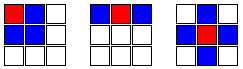
 

where the button pressed is colored red and the affected buttons are blue. Other corner and side moves have an analogous effect.

The applet allows for a second puzzle. Imagine the buttons wrapped on a torus. Then all buttons have exactly the same number of "across-the-edge" neighbors, 4. (In Computer Graphics terms, these are 4-neighbors.) In this modification, all 4-neighbors of a pressed button advance their states along with the button itself. Naturally, the first puzzle is rather Plane whereas the second is played on a Torus. For technical reasons the latter is only played with 3-state buttons.


This applet requires Sun's Java VM 2 which your browser may perceive as a popup. Which it is not. If you want to see the applet work, visit Sun's website at http://www.java.com/en/download/index.jsp, download and install Java VM and enjoy the applet.


Buy this applet
What if applet does not run?

The theory

Copyright © 1996-2008 Alexander Bogomolny

29628770Page copy protected against web site content infringement by Copyscape


Search:
Keywords:


Latest on CTK Exchange
try this puzzle ?/?? + ?/?? + ?/? ...
Posted by albert1950
1 messages
09:11 AM, Aug-12-08

Monty Hall Problem
Posted by linkdon
75 messages
12:48 PM, Aug-05-08

Arbelos : 1) Geometrical Construc ...
Posted by Sundar Krishnan
12 messages
06:29 AM, Aug-12-08

concerning pi
Posted by Lloyd Marks
2 messages
10:51 AM, Aug-15-08

Mistake on the page (an aside, Be ...
Posted by Max
4 messages
10:28 AM, Feb-28-08

New Dissection Of Square Into Six ...
Posted by Bui Quang Tuan
4 messages
07:19 AM, Aug-20-08

You can drill a square hole
Posted by Giorgis
2 messages
08:36 AM, Aug-18-08
