
A Problem of Hinged Squares
What is it?
A Mathematical Droodle

|Activities| |Contact| |Front page| |Contents| |Geometry|
Copyright © 1996-2018 Alexander BogomolnyDiscussion
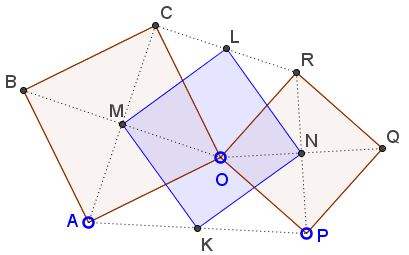
In the applet two squares $OABC$ and $OPQR$ share a common vertex. $M$ and $N$ are centers of the two squares. $K$ and $L$ are the midpoints of $AP$ and $CR,$ respectively. It appears that the quadrilateral $KMLN$ is a square. This is indeed so and is known as the Finsler-Hadwiger theorem.
Consider triangles $AOR$ and $COP.$ $OR = OP.$ Moreover one may be obtained from the other by a suitable rotation through $90^{\circ}$ around $O.$ $OA = OC.$ These too map on each other by the same rotations. Finally, the same is true of triangles $AOR$ and $COP,$ which are thus equal. From here, $AR = CP$ and the two line segments are perpendicular.
In $\Delta APR,$ $KN$ that connects midpoints of sides $AP$ and $PR$ is parallel and equal to half $AR.$ Similarly, in $\Delta ACP,$ $KM$ is parallel and equal to half $CP.$ Therefore, $KM = KN$ and the two are perpendicular.
In an absolutely similar fashion, from the geometry of triangles $CPR$ and $ACR,$ $LM = LN$ and the two are perpendicular. This proves that $KMLN$ is in fact a square.
Here is another proof. Let $M_{90^{\circ}},$ $N_{90^{\circ}},$ and $K_{180^{\circ}}$ denote the rotations around $M$ through $90^{\circ},$ around $N$ through $90^{\circ},$ and around $K\,$ through $180^{\circ}.$ For example, $M_{90^{\circ}}(A) = O,$ $N_{90^{\circ}}(O) = P,$ $K_{180^{\circ}}(P) = A.$ The composition of the three rotations has a fixed point at $A$ and is a rotation through $360^{\circ} = 0^{\circ}\;(\text{mod}\;360^{\circ}).$ It is therefore a translation with a fixed point, i.e. the identity transformation.
Denote the image of $M$ under $N_{90^{\circ}}$ as $M':$ $M' = N_{90^{\circ}}(M).$ ($\Delta MNM'$ is isosceles with angle $N$ being $90^{\circ}.)\;$ Then
$M = K_{180^{\circ}}(N_{90^{\circ}}(M_{90^{\circ}}(M))) = K_{180^{\circ}}(N_{90^{\circ}}(M)) = K_{180^{\circ}}(M'),$
It follows that $M = K_{180^{\circ}}(M').$ But $K_{180^{\circ}}(M')$ is a reflection in $K.$ Therefore $K$ is the midpoint of $MM'.\;$ Therefore $\Delta MNK$ is isosceles with angle $K$ being $90^{\circ}.$
Remark
Squares $OABC$ and $OPQR$ are constructed on the sides $OA$ and OP of $\Delta AOP.\;$ We have just showed that the center of the square built on the line $MN$ of their centers coincides with the midpoint $K$ of $AP.\;$ This fact is known as Neuberg's Theorem.
The Finsler-Hadwiger theorem is also a special case of the Fundamental Theorem of Directly Similar Figures
The theorem is directly equivalent to one of Thébault's statements.
References
- R. L. Finney, Dynamic Proofs of Euclidean Theorems, Math Magazine, 43, pp. 177-185.
- R. Honsberger, In Pólya's Footsteps, MAA, 1997
|Activities| |Contact| |Front page| |Contents| |Geometry|
Copyright © 1996-2018 Alexander Bogomolny74280696