Cut the knot: learn to enjoy mathematics
A math books store at a unique math study site. Shopping at the store helps maintain the site. Thank you.
Math & English enrichment at SchoolPlus-Online
HoodaMath: games and movies
Sites for teachers
Sites for parents
Terms of use
Awards
Interactive Activities

CTK Exchange
CTK Wiki Math
CTK Insights - a blog
Math Help

III Millennium Olympiad

Games & Puzzles
What Is What
Arithmetic/Algebra
Geometry
Probability
Outline Mathematics
Make an Identity
Book Reviews
Stories for Young
Eye Opener
Analog Gadgets
Inventor's Paradox
Did you know?...
Proofs
Math as Language
Things Impossible
Visual Illusions
My Logo
Math Poll
Cut The Knot!
MSET99 Talk
Other Math sites
Front Page
Movie shortcuts
Personal info
Privacy Policy

Guest book
News sites

Recommend this site

Games to relax

Sites for teachers
Sites for parents

Education & Parenting

Manifesto: what CTK is about Buying a book is a commitment to learning Table of content Things you can find on CTK Chronology of updates Email to Cut The Knot Recommend this page

Circles in Morley's Triangles: What is this about?
A Mathematical Droodle


This applet requires Sun's Java VM 2 which your browser may perceive as a popup. Which it is not. If you want to see the applet work, visit Sun's website at http://www.java.com/en/download/index.jsp, download and install Java VM and enjoy the applet.


Buy this applet
What if applet does not run?

(The numbers are clickable and so may be modified.)

Explanation. See also the page on Morley Constellation.

Copyright © 1996-2009 Alexander Bogomolny


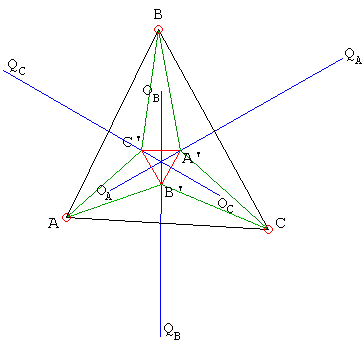
What's happening is this. Let r be a number between 0 and 1. We shall perform a construction similar to but more general than Morley's. For vertex A, measure angles rA from both sides, and similarly for the vertices B and C. The lines adjacent to one of the sides of the given triangle intersect forming seven triangles: the middle one -- Morley's if r = 1/3 -- and 3 pairs of "opposite" triangles. It appears that the lines joining incenters of the opposite triangles are concurrent. It also seems to be true of the circumcenters. We can prove the latter when r = 1/3.
Theorem (by Nikos Dergiades with an important correction by Samuele Mongodi)

Let A'B'C' denote the Morley triangle. Denote the circumcenters of triangles AB'C', BC'A', and CA'B' OA, OB and OC, and those of triangles BCA', CAB', and ABC' QA, QB and QC, respectively. Let angles A = 3x, B = 3y, C = 3z.

Since it's known that BA'C' = 60o + z, BQAA' = 2z (as central angle subtending the same arc as the inscribed angle BCA') and QAA'B = 90o - z (see below) we have QAA'C' = 150o, which means that the line QAA' is the bisector of angle A' in Morley's triangle A'B'C'. Hence, it's also the perpendicular bisector of B'C'. As such, it passes through OA.

Similar statements are true with regard to OBQB and OCQC, which means that the three lines meet at the center of Morley's triangle.

(Some of the triangles have already been considered elsewhere.)

Samuele Mongodi found a flaw in the original Nikos' argument and offered the following fix:

Since QA is the circumcenter of BCA',BA'QA is isosceles, so that QABA' = QAA'B. In combination with BQAA' = 2z, as noted by Nikos, this yields

  QAA'B = (1800 - 2z)/2 = 900 - z,

as claimed.

Copyright © 1996-2009 Alexander Bogomolny

33066415Page copy protected against web site content infringement by Copyscape


Search:
Keywords:

Google
Web CTK