
Carpets in a Parallelogram
Points P, Q, R slide on the sides of parallelogram ABCD. Prove that, regardless of their position, the difference between the red areas and the blue area is constant.

|Activities| |Contact| |Front page| |Contents| |Geometry|
Copyright © 1996-2018 Alexander BogomolnyThis is problem #53 from Which Way Did the Bicycle Go? where the problem is solved without mentioning The Carpets Theorem. The latter, however, is obviously relevant here and makes the proof more transparent.
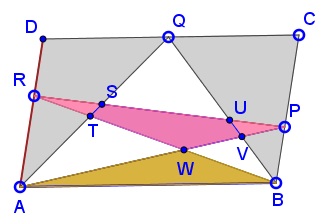
Forget for a moment about points P and R and subdivisions due to their presence. Let RED be the area of two triangles ADQ and BCQ. Clearly
(1)
Area(RST) + BLUE + Area(PUV) = Area(ABW).
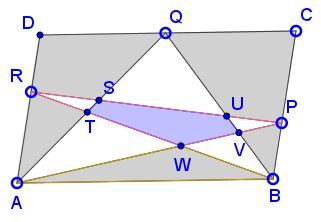
What we have to show (see that the Hint box is unchecked) is that
[RED - Area(RST) - Area(PUV) + Area(ABW)] - BLUE
is independent of the position of the points P, Q, R. But in view of (1)
RED - Area(RST) - Area(PUV) + Area(ABW) - BLUE = RED.
Q.E.D.
References
- J. Konhauser, D. Velleman, S. Wagon, Which Way Did the Bicycle Go?, MAA, 1996, #52
Carpets Theorem
- The Carpets Theorem
- Carpets in a Parallelogram
- Carpets in a Quadrilateral
- Carpets in a Quadrilateral II
- Square Root of 2 is Irrational
- Carpets Theorem With Parallelograms
- Two Rectangles in a Rectangle
- Bisection of Yin and Yang
- Carpets in Hexagon
- Round Carpets
- A Property of Semicircles
- Carpets in Triangle
- Carpets in Triangle, II
- Carpets in Right Triangle
- Piecewise Carpets in Parallelogram
|Activities| |Contact| |Front page| |Contents| |Geometry|
Copyright © 1996-2018 Alexander Bogomolny74280734